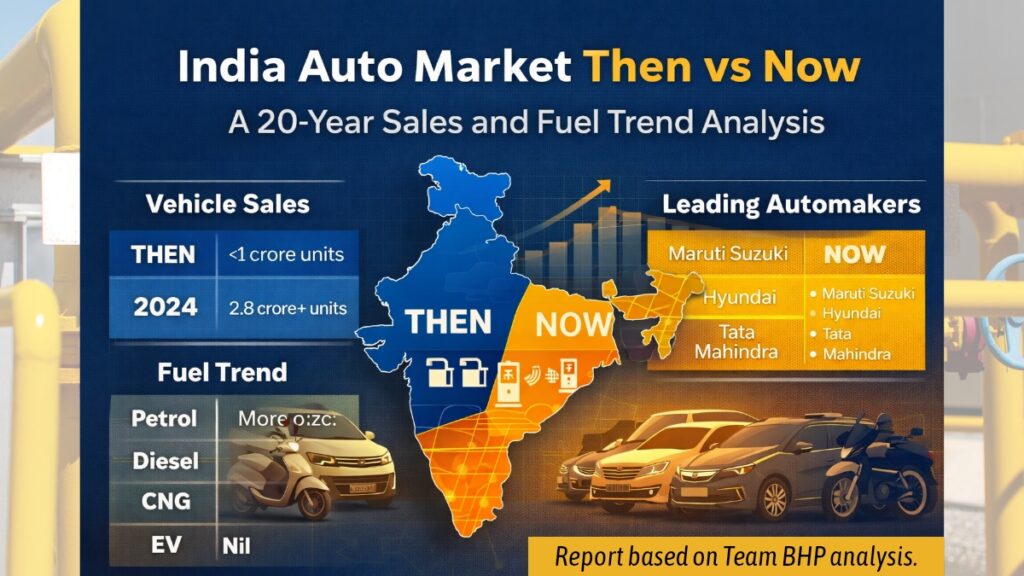
India’s automobile market has seen massive changes over the past two decades — not just in total vehicles sold, but also in who leads the market, which fuel types are growing, and how consumer preferences have evolved. A recent Team-BHP analysis of OEM and fuel data offers deep insight into these shifts.
2025: A Record Year, But With Interesting Patterns
According to industry data, 2025 emerged as one of the strongest years for Indian vehicle sales, crossing several historic highs:
Total vehicles sold reached around 2.82 crore units, pushed in part by tax changes and festive demand.
- Passenger cars and two-wheelers both grew strongly, with passenger cars seeing about 10% year-on-year growth.
- Despite steady overall growth, goods carriers and passenger commercial vehicles didn’t break lifetime records — though they still posted solid gains.
Despite steady overall growth, goods carriers and passenger commercial vehicles didn’t break lifetime records — though they still posted solid gains.
Cars: A Long-Term Look at OEM Leadership
One of the most consistent patterns over the last 20 years is who leads the car segment:
Maruti Suzuki has remained the largest carmaker in India all this time, and even in 2025 holds a dominant position.
Interestingly, despite its size, Maruti has never crossed 50% market share — its peak was about 49.2% around 2020.
Mahindra and Tata Motors have gained ground, especially with aggressive new product launches, creating a more competitive landscape.
Overall, while some players have moved up or down over time, the top OEMs have maintained strong positions — showing both stability and gradual change.
Changing Fuel Mix: Petrol, Diesel, CNG, EVs.
One of the most interesting aspects of the trend analysis is how fuel preferences have evolved among Indian drivers:
1. Petrol Still Rules — But Less than Before.
Petrol cars remain the most common, but their share has been slowly declining as cleaner alternatives gain traction.
2. CNG Is On the Rise.
Sales of CNG vehicles have jumped significantly, reflecting both cost sensitivity and a shift in consumer choice. In fact, CNG cars outsold diesel in FY2025 — a remarkable change compared to previous years.
This rise in CNG has a lot to do with efficient fuel economy and lower operating costs. Maruti Suzuki, Tata, Hyundai and Toyota all benefited from higher CNG sales.
3. Diesel Is Shrinking
Diesel vehicles — once extremely popular — now make up a smaller slice of the market. Even in segments where diesel used to dominate, its share has dropped as buyers move toward petrol and CNG alternatives.
4. EV Adoption Is Gradual
Electric cars still account for a small portion overall — around 2.7% of total car sales — but they’re steadily growing, especially in manufacturers who have invested aggressively in EV models.
Across two-wheelers, EV penetration also rose, reaching record highs around 6.3% in 2025, driven by legacy players like TVS and Bajaj as well as newer EV-focused brands.
What Has Changed Over 20 Years?
Here’s how the fuel mix and consumer preferences have shifted.
- Diesel was once a significant force, especially for cars, but has since declined.
- CNG presence has grown rapidly, especially in small and mid-segment cars.
- Electric vehicles and hybrids are gradually gaining traction — they may still be early adopters compared to petrol and CNG, but the climb is real.
- Government policies around fuel and emissions have consistently shaped what buyers choose, from BS6 emission norms to blending ethanol in petrol.
What This Means for Buyers.
If you’re thinking about your next vehicle purchase, several big trends are worth noting:
- Fuel economy and running costs matter more than ever, which is partly why CNG and even EVs are attractive to many buyers.
- Cars and bikes that are properly aligned with evolving environmental norms and fuel standards are likely to hold value better.
- The market has never offered more choices — from traditional petrol and diesel to CNG, hybrid and pure electric models.
The Indian auto landscape in 2025 looks very different from 20 years ago — not because one thing changed overnight, but because many small shifts combined over time:
- OEM leadership stays strong but competitive.
- Fuel mix has steadily changed as cost, technology and policy evolve.
- EVs and cleaner options are becoming significant players, even if they’re not dominating yet.
For drivers, buyers and auto enthusiasts alike, this means more choice and smarter decision-making are now part of the modern automotive journey.
Source : Team BHP