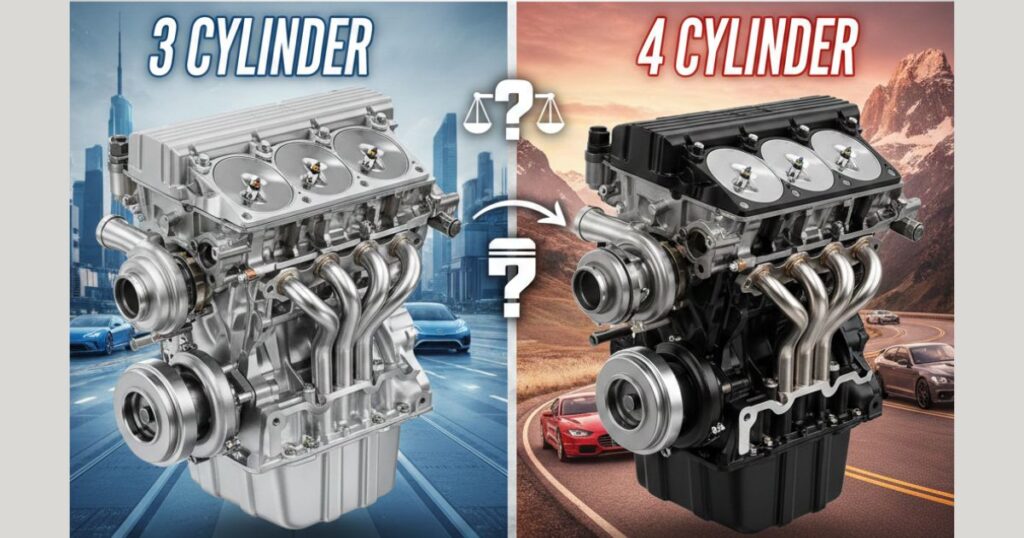
The engine is the heart of any car. One important thing that affects how a car drives is the number of cylinders in its engine. Cylinders are the places where fuel and air burn to produce power. So, whether your car has a 3-cylinder or 4-cylinder engine makes a big difference in how smooth, powerful, and fuel-efficient it feels.
Many people believe that a 4-cylinder engine is always better. But that’s not completely true. The real difference depends on how you use your car. A 4-cylinder engine usually offers more power and smoother performance, but it can be heavier and use more fuel. A 3-cylinder engine, on the other hand, is lighter, more fuel-efficient, and cheaper, making it a good choice for city driving.
Let’s understand both engine types in simple words.
What Is a 3-Cylinder Engine?
A 3-cylinder engine has three combustion chambers placed in a straight line. These engines are small, lightweight, and designed mainly for better fuel efficiency. Because there are fewer cylinders firing, the engine may feel slightly less smooth, especially at high speeds.
Advantages of a 3-Cylinder Engine
1. Compact Size
The engine is smaller, which gives car makers more space. This can help improve cabin space and overall car design.
2. Better Fuel Efficiency
With fewer cylinders, there is less friction and fuel consumption. This makes 3-cylinder engines ideal for daily city use.
3. Lightweight
A lighter engine improves handling and makes the car easier to drive, especially in traffic.
4. Lower Friction
Fewer moving parts mean less metal rubbing against metal, which improves efficiency.
5. Better Interior Space
Because the engine takes up less space, designers can focus more on comfort and interiors.
6. More Affordable
3-cylinder engines cost less to make, so cars with these engines are usually cheaper.
Disadvantages of a 3-Cylinder Engine
1. Slower Response
Power delivery is not as quick as a 4-cylinder engine, especially noticeable during fast acceleration.
2. Less Smooth
These engines can be noisier and produce more vibrations because the firing cycle is not perfectly balanced.
What Is a 4-Cylinder Engine?
A 4-cylinder engine has four cylinders, usually arranged in a straight line. These engines are known for smooth performance, better balance, and stronger power delivery. They are commonly used in medium and large cars.
Advantages of a 4-Cylinder Engine
1. Better Response
Power comes quickly, whether the car is at low or high RPM. There is very little lag.
2. Smoother Drive
The engine fires more evenly, reducing noise and vibration. This makes long drives more comfortable.
3. Balanced Power
Power delivery is consistent, making the car feel strong and stable in all driving conditions.
Disadvantages of a 4-Cylinder Engine
1. Higher Fuel Consumption
More cylinders mean more fuel usage, especially in city traffic.
2. Higher Cost
These engines are more expensive to manufacture, which increases the car’s price.
3-Cylinder vs 4-Cylinder: Quick Comparison
| Feature | 3-Cylinder Engine | 4-Cylinder Engine |
|---|---|---|
| Number of Cylinders | 3 | 4 |
| Smoothness | More vibrations | Very smooth |
| Engine Weight | Light | Heavier |
| Fuel Efficiency | Better | Lower |
| Power Delivery | Slower at low RPM | Strong and quick |
Who Should Buy a 3-Cylinder Engine Car?
A 3-cylinder car is a good choice if you:
- Mostly drive in the city
- Want better mileage
- Are on a budget
- Prefer a small or compact car
Who Should Buy a 4-Cylinder Engine Car?
A 4-cylinder car is better if you:
- Want smooth and powerful performance
- Drive on highways often
- Prefer a quiet and refined driving experience
- Are buying a mid-size or large car
Popular Cars with 3-Cylinder Engines
- Maruti Suzuki Swift
- Tata Nexon
- Tata Punch
- Nissan Magnite
- Toyota Urban Cruiser Hyryder
Popular Cars with 4-Cylinder Engines
- Hyundai Verna
- Toyota Glanza
- Mahindra Thar Roxx
- Tata Curvv
- Land Rover Defender
Final Verdict: Which Engine Is Better?
There is no clear winner in the 3-cylinder vs 4-cylinder debate. Both engines serve different needs.
- Choose a 3-cylinder engine if you want good mileage and a budget-friendly car.
- Choose a 4-cylinder engine if you want more power, smoother driving, and better highway performance.
The best engine is the one that matches your driving style and daily needs.
In short words
The choice between a 3-cylinder and 4-cylinder engine affects your driving experience since they determine several critical factors of the car’s performance. Buyers who prefer power and thrill over fuel efficiency should go for a car with a 4-cylinder engine. However, a 3-cylinder engine car is ideal for those seeking mileage and environmentally friendly performance. Therefore, deciding between the two depends on your priority, driving needs, and budget. The information and differences discussed above are enough to help you decide on the car of your dreams. Weigh the factors and make a decision; a vehicle is a long-term investment.
- Mahindra XUV 7XO Pre-Bookings Start on December 15
- New 2026 MG Hector Facelift Launched Starting Price at ₹11.99 Lakh
FAQ – 3-Cylinder vs 4-Cylinder Engine.
Is a 3-cylinder engine as reliable as a 4-cylinder engine?
The reliability of an engine doesn’t depend on whether it has 3 or 4 cylinders. They have the same materials and build, making them equally reliable.
Why do most of the Tata cars have a 3-cylinder engine configuration?
3-cylinder engine requires less material for design, making it budget-friendly. That’s why Tata cars mostly have a 3-cylinder engine so that they can fall under the economic purchase category.
Why are 3-cylinder engines noisy?
The 3-cylinder engines have a torque imbalance, resulting in a shaking powertrain when the engine moves from metal to metal.
Are 4-cylinder engine cars costlier?
Yes, 4-cylinder engines require more raw material for construction, increasing the overall price of the car.
Do 3-cylinder engines shake?
3-cylinder engines had a reputation for shaking while idling. However, over the years car manufacturers have refined their 3-cylinder engines to reduce the vibrations and shaking during idling.